The Changes and Tempo Workbook
The JazzyMood workbook for playing a standard's chords with the right notes, and bringing it up to the tempo on the record
JazzyMood's Chord Progression Generator spells the chords of a progression in any key, its Scale & Mode Finder spells any scale on any root, and its Song Key & BPM Guide lists each standard's usual key and tempo. None of them says which scale goes with which chord, or what a tempo asks of your hands. The usual shortcut, picking the mode from the chord symbol (m7 means Dorian, 7 means Mixolydian), works on a major ii-V-I and then puts wrong notes on the vi chord, the V7 of a minor key and every chord borrowed from outside the key. The Changes and Tempo Workbook connects the tools, worked on Autumn Leaves in G minor at 130 BPM as the guide lists it. Part 1 reads each chord's scale from its place in the key, builds guide-tone lines from the 3rds and 7ths (Bb A A G G F# F through the tune's opening cycle), shows why the D7 back to G minor wants D Phrygian dominant rather than D Mixolydian (which puts E, F# and B outside the key where only F# belongs), and finds the odd note in every secondary dominant. Part 2 turns a tempo into notes per second (4.33 eighths a second at 130), swings them on the triplet grid (308 ms long, 154 ms short), checks a tapped tempo for half or double, and climbs from a clean 96 to 130 in eight rungs of no more than 5%. Every note is spelled by the site's own tools and every duration computed; the clean and tapped tempos are examples, and the 5% rung and 2:1 swing are named as rules of thumb. It is one common approach to improvising, not a substitute for the records or a teacher. Includes a changes map, a guide-tone page, a tempo ladder log, all 26 standards in the guide worked out, a quickstart, and a personalised sheet worked on the key, progression, scale or tempo you chose.
Look inside
Two full pages from the workbook, exactly as printed. Click either to read it at full size before you decide.
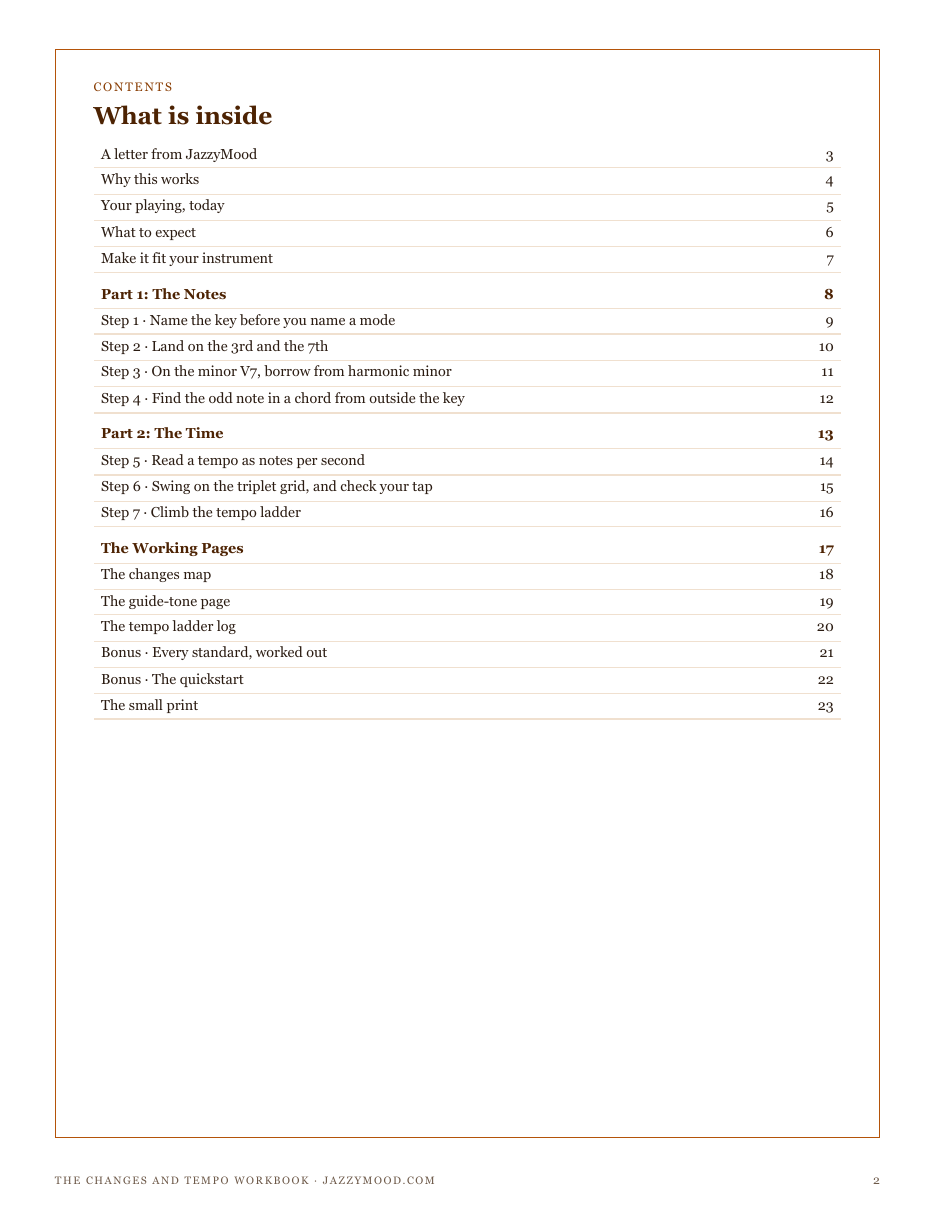
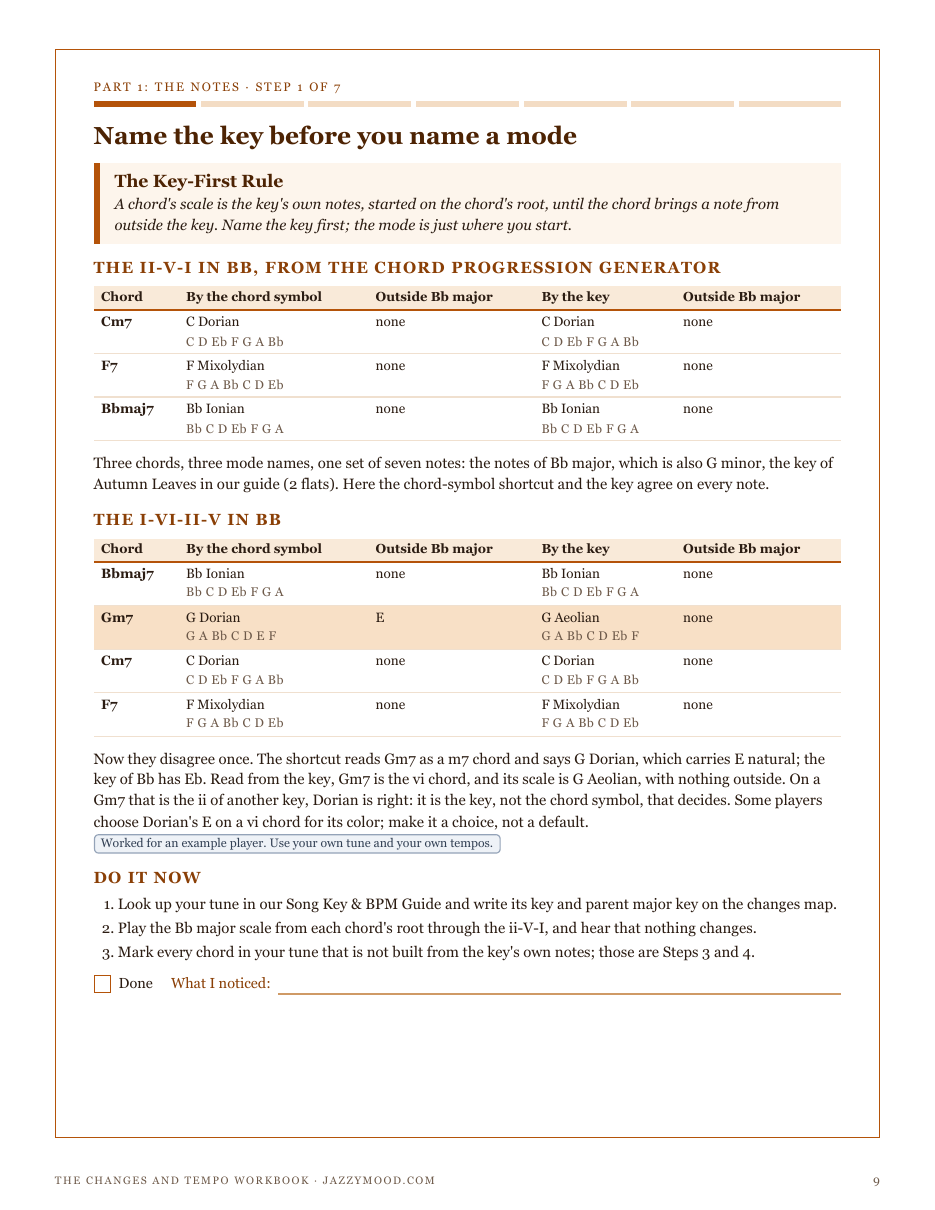
What is in it
- Name the key before the mode: why a ii-V-I is three names for one set of notes, and where the chord-symbol shortcut breaks
- Guide tones: the 3rd and 7th of every chord, and two lines that move by half steps through a standard's opening cycle
- The minor V7: harmonic minor from the dominant's root, and the notes the Mixolydian shortcut gets wrong
- The chord from outside the key: every secondary dominant and the odd note it brings
- Tempo as notes per second, from a ballad's double time to Giant Steps
- Swing on the triplet grid in milliseconds, and the tap check for half or double tempo
- The five-percent tempo ladder from your clean tempo to the record's
- A changes map, a guide-tone page and a tempo ladder log to print
- Every standard in the guide with its parent key, signature, note rate and swing timing, plus a quickstart
- A personalised sheet: your progression mapped chord by chord, your scale's parent key, your tempo ladder and tap check
- ✓ 23 printable pages
- ✓ 10 sections, worksheets and templates
- ✓ A second PDF worked out from the numbers you enter
- ✓ No account needed, just an email address
- ✓ Instant download; link valid 7 days
Price includes any taxes. Sold by GrabURL, who handle checkout and support. The charge appears on your statement as GrabURL.
The workbook picks up where the free Scale & Mode Finder and Chord Progression Generator leave off. They spell a scale and a progression; the workbook connects them: the scale for each chord from its place in the key, the 3rd and 7th to land on, the minor V7 and the chords from outside the key where the chord-symbol shortcut puts wrong notes, then the tune's tempo from the Song Key & BPM Guide as notes per second, swing on the triplet grid, and a ladder from the tempo you play cleanly to the one on the record. A practice method, not a substitute for the records or a teacher.